The traditional press tour involved flying a spokesperson from city to city — New York, Los Angeles, Chicago, Atlanta — for face-to-face interviews with local TV anchors and national correspondents. Each day, three to five interviews. Each city, one or two days. The full tour: a week, sometimes more, of travel, hotels, and exhausted spokespeople.
The virtual press tour replaces all of that with a single studio day.
This is a practical explainer for communications and PR professionals on what virtual press tours are, how they work, and when they make sense for your campaign. Specifically what they are not is just "a Zoom call with a journalist." That is something else, and the difference matters.
What a Virtual Press Tour Actually Is
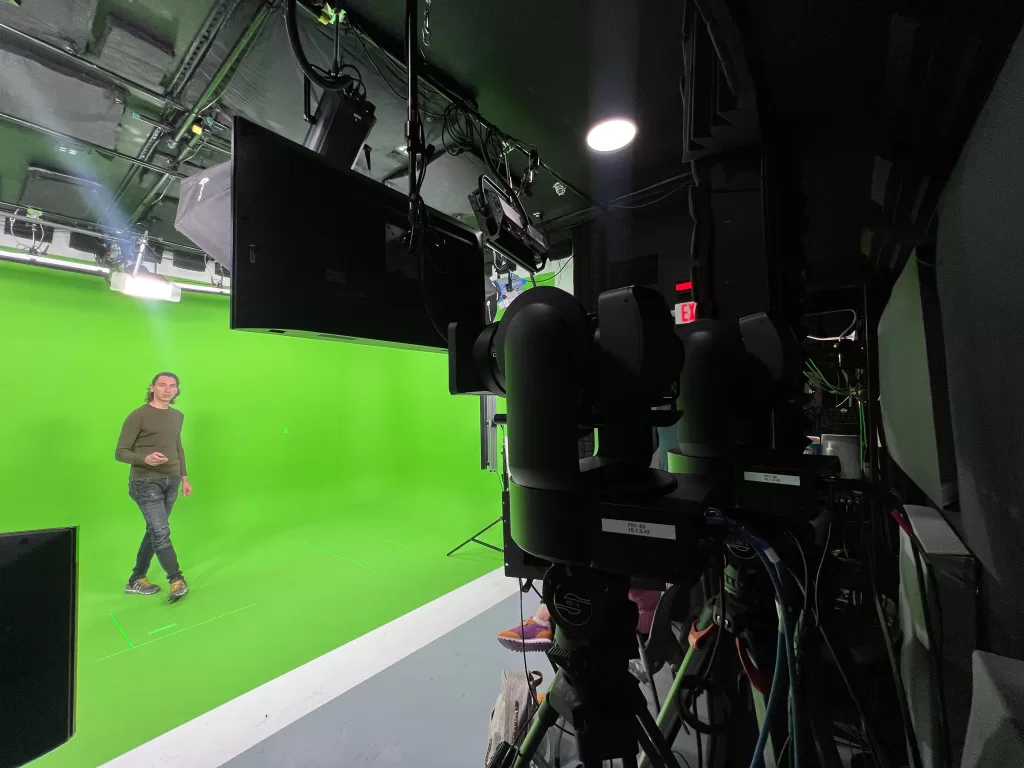
A virtual press tour (VPT) is a structured, broadcast-quality production day where your spokesperson sits in a professional studio while journalists, anchors, and producers from media outlets across the country join remotely via satellite, broadcast IP, or video conferencing.
Each interview is treated as a discrete media engagement: dedicated time, dedicated signal, individualized framing for the outlet's audience. The studio handles signal routing so each outlet receives a clean feed isolated from the others.
The spokesperson stays in one location. The outlets come to them.
The structural differences from a Zoom interview
A Zoom call with a journalist is two people on laptops. A virtual press tour is a broadcast production. The differences:
- Production quality: Broadcast-grade camera, studio lighting, professional audio. The video looks like television, not a webcam.
- Signal isolation: Each outlet receives an independent feed. They are not seeing each other.
- IFB (interruptible foldback): The PR team can communicate directly with the spokesperson via earpiece between or during interviews without it appearing on camera.
- Backup connectivity: Redundant internet (fiber plus microwave) so the signal never drops.
- Scheduling discipline: Outlets are booked in tight windows. The studio runs on broadcast time.
When a Virtual Press Tour Makes Sense
Major announcements with broad geographic interest
Product launches, FDA approvals, acquisition announcements, IPO milestones, executive appointments. Anything where you want broad regional coverage from local TV markets in addition to national outlets.
Local TV markets are often overlooked in modern PR strategy. They drive significant audience reach in their regions, and they are still hungry for credible national-story content delivered with broadcast-quality production. A VPT lets you reach twenty local markets in a single day.
Spokespeople with limited availability
Senior executives, busy physicians, government officials, celebrity spokespeople. Anyone whose calendar makes a multi-city physical tour impossible. A VPT compresses the week into a single day.
Crisis communications
When a story is breaking and you need to deploy a spokesperson immediately to control the narrative across multiple outlets, a VPT is operationally faster than booking flights and hotels. The studio is reserved, signal is up, and the spokesperson can be on air within hours.
Coordinated multi-outlet rollouts
When the PR strategy involves landing the same story in multiple places on the same day, a VPT lets you sequence interviews carefully. National morning shows, then cable, then local affiliates, then podcasts. Each outlet gets a fresh take of the same core message.
When a Physical Tour Still Makes Sense
Despite the obvious efficiency of virtual press tours, physical tours still have a place:
- Long-form narrative pieces. A magazine profile, a documentary, a sit-down with a major print outlet — these often require in-person time with the journalist.
- B-roll integrated stories. If the story includes the executive in a specific environment (their factory, their office, a customer location), filming on location matters.
- Trade show or conference tie-ins. If the announcement is happening in conjunction with a physical event, the spokesperson is already there.
For everything else — and that is the majority of broadcast media work — virtual press tours are now the default.
How a Virtual Press Tour Day Actually Runs
A typical VPT day at a broadcast-grade studio runs like this:
Pre-tour (1-2 weeks before)
The PR team books outlet interviews and locks the schedule. The studio confirms technical specs with each outlet (signal format, scheduling tools, satellite uplink coordination if applicable). Talking points are finalized with the spokesperson.
Tour day, hours 1-2
Spokesperson arrives, hair and makeup, technical check. Tour day starts with a buffer to allow for any signal or scheduling issues to be resolved before going live.
Tour day, hours 2-7
Back-to-back interviews. Each outlet gets a dedicated five-to-fifteen-minute window. Between interviews, brief resets — water for the spokesperson, brief PR check-in via IFB, signal handoff to the next outlet. Interviews can run live or be recorded for later distribution.
Tour day, hours 7-8
Pickups, retakes, additional B-roll if needed. Wrap.
A typical VPT day delivers ten to fifteen completed media engagements. A particularly aggressive day with short five-minute slots can hit twenty.
What to Look for in a Virtual Press Tour Studio
Not every studio can support a VPT properly. The infrastructure requirements are real:
- Fiber gigabit primary internet plus a microwave or wireless ISP backup. Single-path internet is a single point of failure during live media engagements.
- NDI and Dante signal routing. For clean signal isolation between outlets.
- IFB / talkback infrastructure. So PR teams can communicate with the spokesperson without it appearing on camera.
- Compatible with major broadcast transmission services. Dejero, LiveU, Zixi, satellite uplinks, and standard RTMP.
- A team that has done it before. The format is unforgiving. The studio team needs to be familiar with broadcast pacing, IFB protocols, and the inevitable last-minute outlet additions.
The Bottom Line
Virtual press tours are not a downgrade from physical tours. For most modern PR campaigns, they are the better tool. They reach more outlets, cost less, exhaust spokespeople less, and provide more reliable production quality than a flying schedule does.
The decision to use one is not "are we settling for virtual instead of physical." It is "what specifically do we need from each format, and how do we combine them strategically." For most product launches, executive announcements, healthcare communications, and crisis responses, the answer is virtual.
Build your studio quote in minutes.
Select your dates, package, and add-ons online. Our team reviews every submission and confirms availability quickly.
Build Your Quote →